- 800-435-2948
- 800-435-2948
Metallurgists have worked for over 160 years in developing more resilient metals for threading difficult-to-machine materials. Nowadays, the amount of different raw materials available to manufacture threading taps is exceptional. This is a necessity since there’s no one material that’s suitable for threading all types of matter.
In addition to the tap material, taps can now utilize special coatings and tip configurations for even more customization options, depending on your specific needs and application.
High-speed steel (HSS) has remained a popular tap material for decades because it can maintain its integrity while threading, despite high temperatures and vibration. Various types of high-speed steel exist, but the main “ingredients” include high carbon tool steel, tungsten, chromium, vanadium, and iron.
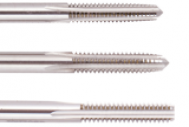
The term “carbide” is short for “tungsten carbide,” which is a type of steel made from carbon atoms and tungsten. Solid carbide is much denser than steel and has a high resistance to friction and heat.
Although resistant to an abrasive material, solid carbide tends to be brittle and doesn’t withstand vibrations as well as other tap materials. For that reason, solid carbide taps should be used only with modern, high-speed cutting equipment that has minimal vibration while operating.
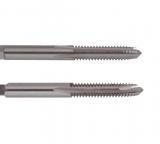
Although solid carbide is more expensive than high-speed steel, keep in mind that it’s ultra-durable and capable of maintaining a sharp cutting edge much longer than HSS. Using solid carbide means you’ll go through fewer taps and spend less time changing out taps.
Consider threading taps made from solid carbide if you need taps to:
SuperTuf particle metal was created by in-house research and development specialist, who combined HSSE particle metals with super microparticle metals. Taps made from SuperTuf exhibit excellent hardness, heat absorption, and abrasion resistance.
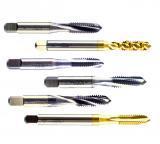
The term “carbo-clad” refers to tap material that has strips of carbide brazed into the steel body of the tap. These taps are highly durable due to the carbide, while the steel provides greater torsional strength. The resulting tap has better shock absorbency than solid carbide.
Taps that are carbo-clad carbide tipped work very well on hard, nonferrous materials like aluminum, bronze, cast iron, and hard copper. However, they are not recommended for threading taps in steel.